
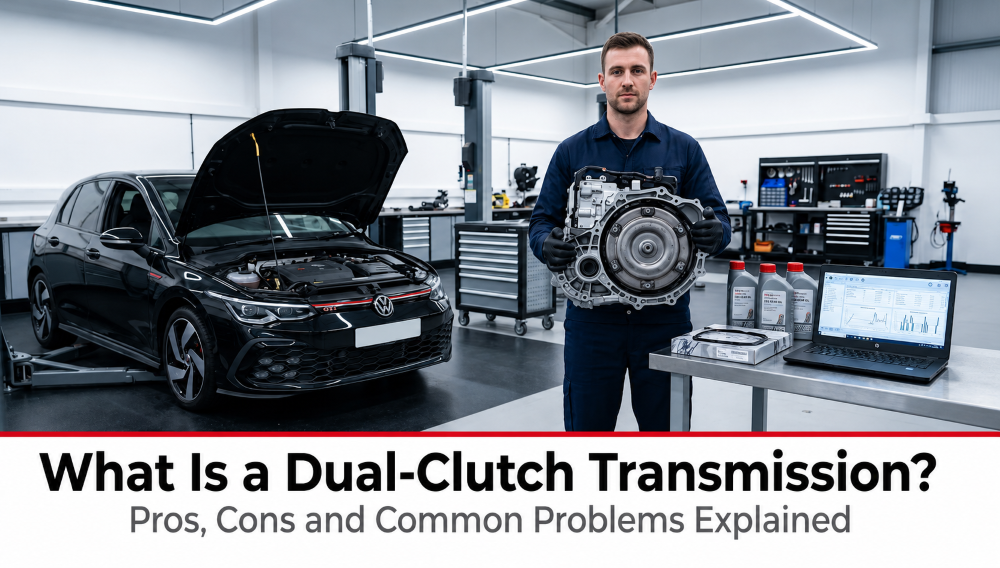
A dual-clutch transmission gets talked about two very different ways. Performance drivers love it for shifts that feel almost instant. Mechanics see a different side the expensive repair bills that show up when one gets neglected. Both things are true, and which one applies to you mostly comes down to how the car is driven and maintained. This guide covers what a DCT actually is and how it works, the real pros and cons, a genuinely detailed look at the common problems that send these gearboxes in for repair, what maintenance actually looks like, roughly what it costs, and how a DCT stacks up against a traditional automatic or manual.
What Is a Dual-Clutch Transmission (DCT)?
A dual-clutch transmission, sometimes called a twin clutch transmission or dual shift transmission, is essentially two separate manual gearboxes built into one housing, each controlled by its own clutch. One clutch handles the odd-numbered gears (1st, 3rd, 5th), the other handles the even-numbered gears (2nd, 4th, 6th). While you’re driving in one gear, the transmission’s control system has already pre-selected the next likely gear on the other clutch. When it’s time to shift, one clutch disengages at almost the exact instant the other engages which is why a dual clutch gearbox can shift so much faster than a traditional automatic. There’s no torque converter slushing power through fluid; it’s a mechanical handoff, executed automatically.
How Does a DCT Work?
The basic handoff mechanism is the same across every DCT transmission, but there’s an important technical split that most explainers skip entirely: wet-clutch versus dry-clutch DCT systems.
Wet-Clutch DCT
A wet-clutch system runs its clutch packs bathed in transmission fluid, which continuously cools and lubricates them. This makes wet-clutch DCTs generally more durable under higher torque loads and better suited to performance applications and heavier vehicles, since the fluid carries heat away from the clutches far more effectively than air alone.
Dry-Clutch DCT
A dry-clutch system, by contrast, works more like a traditional manual clutch no fluid bath, just friction material engaging directly. It’s lighter, cheaper to produce, and often used in smaller-engine, lower-torque cars where fuel economy is the priority. The trade-off is heat management: without fluid cooling, dry-clutch systems are generally more prone to overheating and premature wear in stop-start city traffic, where the clutch is engaging and slipping constantly at low speed. This distinction matters when you’re diagnosing a problem or deciding how to drive a DCT-equipped car a dry-clutch system in heavy traffic is working a lot harder than the same car cruising on the highway.
Pros of a Dual-Clutch Transmission
- Faster gear shifts changes happen in a fraction of a second, with none of the pause associated with a traditional torque-converter automatic
- Better fuel efficiency than many traditional automatics the direct mechanical engagement loses less energy than a fluid-based torque converter
- A sportier, more connected driving feel quick, precise shifts under hard acceleration make a DCT a favourite in hot hatches and performance models
Cons of a Dual-Clutch Transmission
- Higher repair and maintenance costs: more complex internals mean repairs are typically pricier than a conventional automatic
- Low-speed jerkiness: particularly in dry-clutch systems, which can feel hesitant or slightly jerky from a standstill or in stop-start traffic
- Clutch wear if driven hard or neglected: aggressive launches, heavy traffic use, and skipped fluid services all accelerate wear on the clutch packs
Common Dual-Clutch Transmission Problems
This is the section that matters most if you’re trying to work out whether a symptom you’re noticing is normal DCT character or an actual problem so it’s worth going through in real detail rather than a quick list.
Delayed Engagement or Hesitation From a Stop
One of the most common complaints with DCT-equipped cars, particularly dry-clutch systems, is a noticeable pause or hesitation when pulling away from a standstill almost like the car is thinking about it before engaging. A small amount of this can be normal DCT character, but a pronounced delay, especially if it’s worsened recently, often points to clutch wear or a control module starting to struggle with engagement timing.
Clutch Shudder Under Load or When Accelerating
A shudder or vibration felt through the car under acceleration, especially at lower speeds or under load (like pulling away uphill), is a classic sign of clutch pack wear or contamination. It typically feels like a juddering sensation rather than a smooth take-up of power, and it tends to get more noticeable over time rather than resolving on its own.
Overheating in Heavy Traffic or Hot Weather
Dry-clutch systems in particular can struggle in stop-start traffic on hot days, since the clutch is repeatedly slipping and engaging without the cooling benefit of a fluid bath. Overheating often triggers the transmission to enter a protective “limp mode,” restricting gears or power until the system cools down an inconvenient but deliberately protective response.
Mechatronic Unit or Control Module Faults
The mechatronic unit is the electro-hydraulic brain that controls clutch engagement and gear selection. When it develops a fault whether from a sensor issue, internal wear, or a software glitch symptoms can range from rough or delayed shifts to the transmission defaulting into a limited “limp home” mode. Mechatronic issues are one of the more involved DCT problems to diagnose, often requiring dedicated diagnostic software to pinpoint the fault before deciding whether a repair, reflash, or replacement is needed.
Fluid Degradation and Its Effect on Shift Quality
DCT fluid isn’t just a lubricant in wet-clutch systems especially, it’s central to clutch cooling and smooth engagement. As it ages, it loses its ability to protect and cool the clutch packs properly, and shift quality typically degrades gradually: slightly rougher shifts, a bit more hesitation, subtle shudder that builds over months rather than appearing overnight. This is exactly why fluid service intervals matter more for a DCT than for a lot of other transmission types.
Warning Light Triggers
Most DCT-equipped cars will trigger a dashboard warning light sometimes a generic engine light, sometimes a transmission-specific icon when the control system detects a fault outside its normal operating parameters. Because these systems are computer-managed, a warning light is usually the transmission itself flagging a problem before it becomes a bigger one, which makes it worth taking seriously rather than waiting to see if it clears on its own.
Warning Signs It’s Time to Get Your DCT Checked
- Shuddering or juddering when accelerating from a stop or under load
- A burning smell, particularly after stop-start driving or hot weather
- Any transmission or engine warning light appearing on the dash
- Harsh, delayed, or inconsistent gear shifts that weren’t there before
- The car entering a noticeably restricted “limp mode” or losing access to higher gears
How to Maintain a Dual-Clutch Transmission
A DCT rewards regular maintenance more than most transmission types, largely because the tight tolerances and clutch-cooling reliance leave less margin for neglect.
- Fluid changes at manufacturer intervals: many manufacturers recommend a service somewhere in the range of every 60,000–80,000km, though this varies significantly by make and model, so always follow your specific vehicle’s logbook rather than a generic rule
- Software and control module updates: manufacturers periodically release updates that refine shift logic and clutch engagement, and keeping these current can meaningfully smooth out minor quirks
- Regular inspection for leaks or unusual noise: catching a small fluid leak or an early whine before it progresses is far cheaper than waiting for a full symptom to develop
How Much Does DCT Maintenance and Repair Cost?
Costs vary hugely depending on make, model, and what’s actually wrong, so treat the following as general, illustrative ranges rather than a quote for your specific car:
- Routine fluid service: roughly $300 to $600, depending on the vehicle and fluid type required
- Clutch pack repair or replacement: roughly $1,500 to $4,000+, depending on the extent of wear and parts required
- Mechatronic unit repair or replacement: roughly $2,000 to $6,000+, reflecting the complexity of the component and labour involved
These figures are broad estimates only. The actual cost for any specific vehicle depends on the make and model, the severity of the fault, and the workshop carrying out the work always get a proper diagnostic and quote before assuming the worst.
DCT vs Automatic vs Manual: Which Is Right for You?
| Transmission Type | Shift Speed | City Driving Comfort | Typical Maintenance Cost | Best For |
|---|---|---|---|---|
| Dual-Clutch (DCT) | Fastest — near-instant | Good in wet-clutch systems; can feel jerky in dry-clutch systems at low speed | Generally higher | Spirited driving, performance cars, drivers who want quick shifts |
| Torque-Converter Automatic | Smooth but slower than DCT | Very smooth, especially in stop-start traffic | Generally moderate | Comfort-focused daily driving, towing, relaxed commuting |
| Manual | Slowest (driver-dependent) | Comfort depends on driver skill and traffic | Generally lowest | Drivers who want full control and lower long-term running costs |
There’s also the increasingly common comparison of DCT vs CVT (continuously variable transmission): a CVT prioritises smoothness and fuel efficiency through a belt-and-pulley system with no fixed gears, while a DCT prioritises quick, distinct gear changes and a more engaging driving feel. Neither is universally “better” it depends whether you value seamless comfort or a sportier connection to the drivetrain.
Which Cars Use Dual-Clutch Transmission?
DCTs are common across performance and European models in particular. Well-known examples include:
- Volkswagen Golf GTI and Golf R (DSG dual-clutch)
- Audi S3 and other S-tronic-equipped Audi models
- Hyundai i30 N (available with an N DCT option)
- Porsche 911 and other PDK-equipped Porsche models (a wet-clutch DCT known for its durability under high performance use)
Honda has also used dual-clutch systems in select performance models, and several other manufacturers offer DCT options across their performance ranges always check the specific model year and market, since transmission offerings change frequently and some previously DCT-equipped nameplates have since been discontinued or switched to other transmission types.
How Long Does a DCT Last?
With proper maintenance regular fluid changes, prompt attention to early warning signs, and reasonably sensible driving a dual-clutch transmission can reasonably be expected to last as long as the rest of the vehicle, often well beyond 150,000 to 200,000km. Neglected fluid services, sustained hard driving, or ignoring early symptoms like shudder or hesitation can bring that timeline forward considerably, sometimes requiring major clutch or mechatronic work well before that point.
Frequently Asked Questions
Is DCT better than automatic?
It depends what you value. A DCT generally shifts faster and can be more fuel-efficient, but a traditional torque-converter automatic is usually smoother in stop-start traffic and typically cheaper to maintain over time.
How often should I service a DCT?
Follow your vehicle’s specific logbook schedule, but many manufacturers recommend a fluid service somewhere in the 60,000 to 80,000km range always confirm the exact interval for your make and model rather than relying on a generic figure.
What are common DCT problems?
The most frequent issues are delayed engagement from a stop, clutch shudder under acceleration, overheating in heavy traffic (especially in dry-clutch systems), mechatronic control faults, and gradual shift-quality decline as the fluid ages.
How long does a dual-clutch transmission last?
With proper maintenance, many DCTs comfortably reach 150,000 to 200,000km or more, though neglected servicing or consistently hard driving can shorten that considerably.
Is a DCT expensive to repair?
Generally yes, relative to a conventional automatic clutch pack and mechatronic unit repairs in particular tend to sit at the higher end of transmission repair costs, though routine fluid servicing is comparatively affordable.
Get Your DCT Checked in Rydalmere
If your dual-clutch transmission is shuddering, hesitating, throwing a warning light, or just doesn’t feel like it used to, it’s worth getting a proper diagnostic before the problem has a chance to get more expensive. At I-FIX Autohaus in Rydalmere, our ASE certified technicians work across all makes and models, including the European and performance vehicles that DCTs are most commonly found in, and every diagnostic and repair is backed by our 12 month / 12,000km nationwide warranty. Call us on 1300 010 888 or book a transmission check online and we’ll give you a clear, honest read on what’s actually going on.
