Introduction
Buying a used car in Sydney comes with real financial risk if you skip proper due diligence. Beyond the obvious mechanical concerns, Australian buyers also need to worry about vehicles with money owing, a written-off history, or worse, a stolen vehicle being sold under a false identity. A thorough vehicle check before buying isn’t just about kicking the tyres and listening to the engine it’s a structured process that covers legal history, physical condition, and real-world driving performance, ideally finished with the kind of professional inspection a private driveway simply can’t replicate. This guide walks through exactly how to check a used car like a pro, step by step, whether you’re buying privately, from a dealer, or at auction anywhere across Sydney.
Step 1: Performing a Legal & Financial Check
Before you even look at the car itself, run a PPSR (Personal Property Securities Register) check using the vehicle’s VIN or registration number. This official government check confirms whether there’s finance still owing on the vehicle, whether it’s recorded as written off following an accident, and whether it appears on the stolen vehicle registry. Skipping this step is one of the most common and costly mistakes used car buyers make in Australia, since a car can look perfect and still come with someone else’s outstanding loan attached to it, which can legally follow the vehicle even after you’ve paid for it. This single check, which takes only a few minutes online, is non-negotiable before you go any further.
Step 2: Physical Exterior & Body Inspection
With the legal side confirmed, move on to a proper walk-around in good daylight. Check panel alignment at every gap around the doors, bonnet, and boot, since inconsistent gaps or panels sitting slightly proud of their neighbours often point to prior crash repair. Look closely at paint consistency across all panels subtle colour or texture differences between panels are one of the clearest giveaways of a respray following an accident. Check for rust spots, particularly around wheel arches, sills, and door edges, as well as glass condition across all windows and the windscreen, noting any chips, cracks, or signs of prior replacement that don’t match the vehicle’s stated history.
Step 3: Mechanical & Under the Bonnet Checks
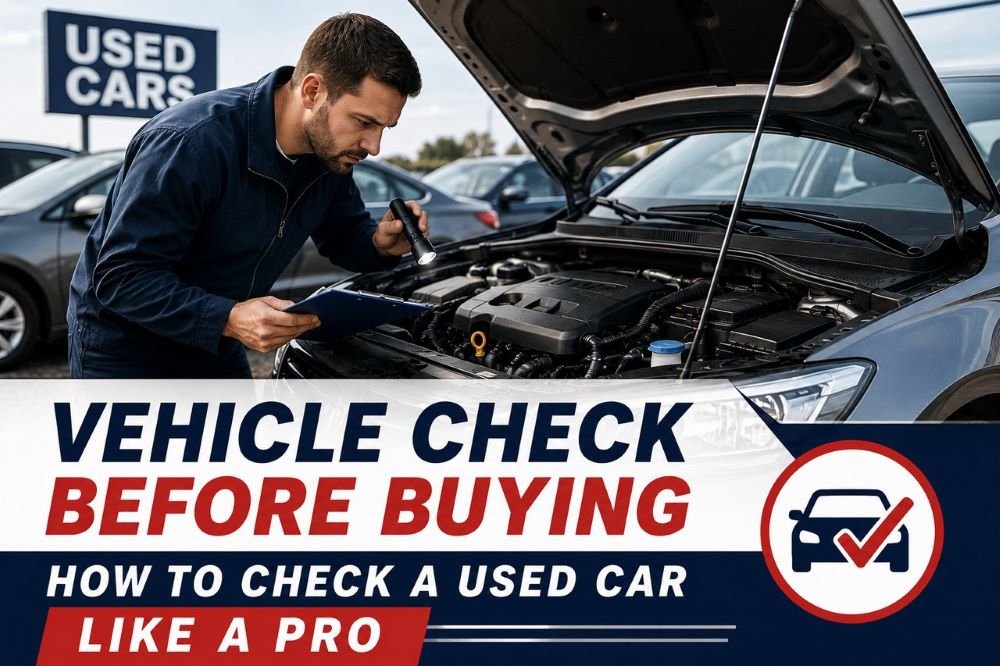
Open the bonnet and check the engine oil for purity it should be relatively clean and free of a milky appearance, which can indicate coolant contamination and a more serious internal issue. Inspect the cooling system, including coolant colour and condition, along with hoses and belts for cracking, fraying, or perishing. Check thoroughly around the engine bay for any signs of oil, coolant, or fluid leaks. One test many buyers skip is the cold start: if possible, arrange to see the car started from completely cold, since this is when engine noises, rough idling, or excessive smoke are most likely to reveal themselves a warm engine that’s already been running before you arrive can easily mask these issues.
Step 4: Cabin & Electrical System Inspection
Inside the car, turn the ignition on and check that every warning light illuminates briefly and clears correctly, paying particular attention to the airbag light, which should never stay illuminated. Test the air conditioning for proper cooling performance, along with power windows, central locking, and any other electrical accessories the vehicle is fitted with. Check pedal wear and seat condition against the stated odometer reading heavily worn pedal rubber or a sagging driver’s seat on a car claiming low kilometres is a red flag worth investigating further, and it’s a detail many buyers overlook in favour of just looking at the dashboard number.
Step 5: The Comprehensive Road Test
No how to check used car process is complete without driving it properly. Pay close attention to transmission shifting, whether automatic or manual, noting any hesitation, harsh changes, or slipping between gears. Check that the steering tracks straight without pulling to either side, and pay attention to suspension feel over bumps and rougher road surfaces knocking, clunking, or excessive bounce all warrant a closer look. Test brake response at both low and higher speeds, feeling for pulling, vibration, or a spongy pedal. Where possible, include some motorway-speed driving as part of the test a stretch along the M4 or Parramatta Road gives a much better indication of how the vehicle handles sustained higher speeds than a short suburban loop ever will.
On-Hoist Mechanical Inspection & ECU Scans
A driveway inspection, no matter how thorough, has real limits. Without a hoist, you simply can’t see the underside of the vehicle properly — suspension components, exhaust condition, structural rust, or signs of prior underbody repair all go unseen from ground level. Modern vehicles, particularly European models, also run on complex CAN-bus electronic architecture, meaning fault codes and sensor issues can be sitting in the ECU without producing any noticeable symptom yet. This is exactly why a professional on-hoist inspection paired with a dealer-grade diagnostic scan catches problems that even the most careful driveway check will miss. At
I-Fix Autohaus, our Pre-Purchase Inspection service combines a 130+ point physical inspection on a proper workshop hoist with dealer-grade ECU diagnostic scanning, giving Sydney buyers the complete picture a private inspection simply can’t provide.
Conclusion
A genuine vehicle check before buying covers three layers working together: confirming the car’s legal and financial history through a PPSR check, physically inspecting the body and mechanicals, and putting the vehicle through a proper road test. Each layer catches different risks, and skipping any one of them leaves a real gap in your due diligence. Once you’ve done your own checks and you’re seriously considering a vehicle, the smartest next step is a professional pre-purchase inspection before you commit to a deposit.
FAQ
1. What’s the first thing I should check before buying a used car?
The very first step should always be a PPSR (Personal Property Securities Register) check, before you even inspect the vehicle in person. This confirms whether there’s finance still owing, whether the car has a written-off history, or whether it’s recorded as stolen all of which can have serious legal and financial consequences for you as the buyer, regardless of how good the car looks or drives. Only after this check comes back clean is it worth investing time in a physical inspection and test drive.
2. Is a PPSR check enough, or do I still need a mechanical inspection?
A PPSR check only covers the vehicle’s legal and financial history it tells you nothing about its physical condition, mechanical health, or whether it’s been in an undisclosed accident that wasn’t formally written off. A mechanical inspection is a completely separate and equally important step, covering everything from engine condition to suspension wear and electronic fault codes. A genuinely thorough vehicle check before buying always includes both a PPSR check and a proper physical and mechanical inspection one doesn’t substitute for the other.
3. Can I do a proper used car inspection without a hoist or professional tools?
You can absolutely catch a lot of common issues with a careful driveway inspection and test drive, and it’s a worthwhile first filter before committing further time to a vehicle. However, a hoist gives access to the underside of the car suspension, exhaust, and structural condition that’s simply invisible from ground level, and a professional diagnostic scanner can reveal ECU fault codes that produce no visible symptoms yet. For any vehicle you’re seriously considering, particularly a higher value or European model, a professional on-hoist inspection is worth the investment before you finalise the purchase.
