
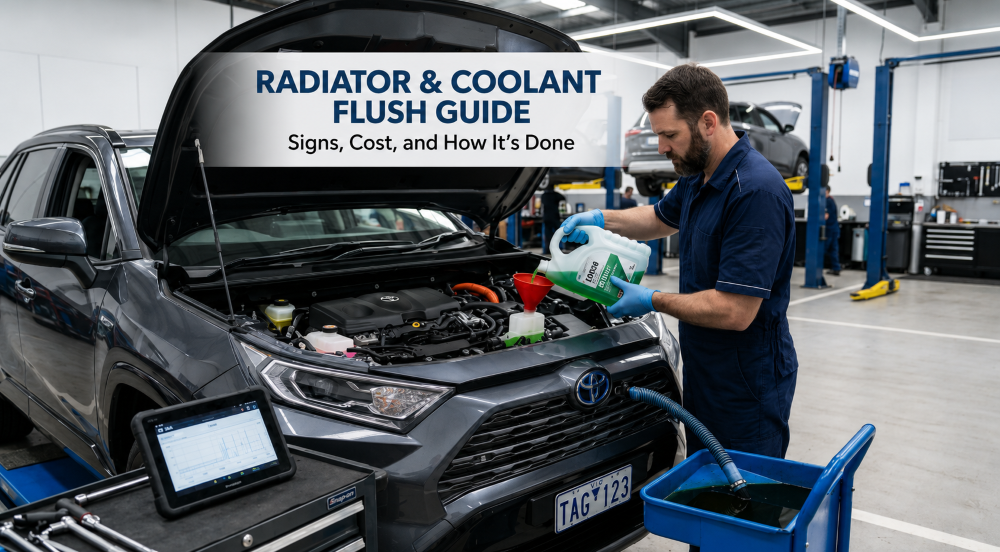
If your temperature gauge has been creeping up, there’s a sweet smell from the engine bay, or you’re not sure when your radiator was last flushed, this guide covers what most radiator flush articles skip: why mixing coolant types can gel up your system, how to tell it’s time for a flush, and what it costs in Sydney.
What Does Coolant Actually Do?
Coolant, or antifreeze, circulates through your engine, radiator, and heater core, absorbing heat and releasing it through the radiator. Without it, your engine would overheat in traffic or, in cold weather, freeze and crack the block. It’s a 50/50 mix of water and glycol-based antifreeze that regulates temperature while carrying corrosion inhibitors protecting the water pump and radiator from rust. Like brake fluid, it doesn’t last forever once those inhibitors break down, old coolant contributes to the rust it’s meant to prevent, which is why a radiator flush is a genuine maintenance job, not just a top-up.
Coolant Types and Colours Why Mixing Them Is a Real Problem
This is the biggest thing missing from most DIY radiator flush guides, and the mistake that causes the most expensive damage. Coolant isn’t one universal fluid there are several chemical formulations (IAT, OAT, and HOAT), and they’re not all compatible. Colour isn’t a reliable guide: green usually means older IAT coolant, while orange, red, pink, or turquoise can indicate a longer-life OAT or HOAT formula, but manufacturers aren’t consistent about it. Mixing incompatible types can react into a gel-like sludge that clogs the radiator and engine passages. Always check your owner’s manual for the exact specification rather than matching the colour in the bottle.
Signs You’re Overdue for a Radiator or Coolant Flush
A rising temperature gauge or an overheating engine is the clearest warning sign, but there are subtler ones too. Coolant that looks rusty brown or resembles chocolate milk has lost its protective properties. A sweet smell often points to a leak, and a weaker heater can mean trapped air or a blocked heater core. If you’re topping up more often, or it’s been two years or 40,000km since the last flush, get it checked rusty or milky coolant shouldn’t just be topped up, since that’s contamination a flush needs to address. Most manufacturers set the interval at 2 years or 40,000km, though some long-life OAT coolants run to 5 years or 100,000km check your logbook, as this is included in every logbook service we run at I-FIX AUTOHAUS.
Flush vs. Topping Up
Topping up adds a small amount of coolant to bring the reservoir back to level, without removing the old fluid fine if the level has simply dropped slightly. A proper radiator flush fully drains the old coolant, refills, and bleeds air pockets from the system. If the coolant is old, contaminated, or the wrong type may have been added, only a full flush resolves it.
How a Professional Radiator & Coolant Flush Works
The process starts with the engine completely cool, since a hot cooling system is pressurised and can cause burns if opened. Old coolant is drained from the radiator, and where accessible, the engine block is drained separately for a thorough flush. A flush product or fresh water clears sediment before fresh coolant, matched to the manufacturer’s exact specification, is added at the correct dilution. The step most DIY radiator flushes get wrong is bleeding the radiator system afterwards clearing trapped air, often by running the engine with the heater on max and, on some vehicles, opening specific bleed valves. Left unbled, air can sit in the heater core and leave it blowing cold, or create hot spots that lead to overheating. A final test drive confirms there’s no trapped air, and the temperature holds steady.
Radiator & Coolant Flush Cost in Australia
| Service | Typical Cost Range (AUD) |
|---|---|
| Standard radiator/coolant flush (passenger car) | $80 to $180 |
| Engine block drain or specific bleed procedure required | $150 to $280+ |
| Coolant leak diagnosis (if overheating is present) | Quoted separately |
DIY coolant and a flush product might only cost $40 to $70, but the risks are real wrong coolant type, air left in the system, or a slow leak a professional inspection would otherwise catch early.
DIY or Professional?
Old, depleted coolant is a genuine risk to expensive components, not just a box to tick. Corrosion inhibitor breakdown lets rust attack the water pump, and persistent overheating from a compromised system is one of the more common causes of head gasket failure — a far more expensive repair than a flush. Before tackling this yourself, know your car’s exact coolant specification, be confident you can fully bleed the radiator system, and check there’s no existing leak, since a flush won’t fix a leaking hose, water pump, or radiator. Old coolant is also toxic to pets and classified as hazardous waste, so it can’t be poured down a drain. If any of that gives you pause, have it done properly rather than risking a gel-up or an air pocket that leaves you stranded.
Frequently Asked Questions
How often should engine coolant be changed?
Typically every 2 years or 40,000km, though some long-life coolants last up to 5 years or 100,000km.
How much does a radiator or coolant flush cost?
Typically $80 to $180 for a standard passenger vehicle, rising to $280+ if an engine block drain or specific bleed procedure is required.
What’s included in a radiator flush service?
A proper radiator flush service drains the old coolant, clears sediment, refills with the correct coolant specification, bleeds trapped air from the radiator, and checks for leaks not just a coolant top-up.
Book Your Radiator & Coolant Flush with I-FIX AUTOHAUS
Coolant is easy to ignore until the temperature gauge climbs on a hot Sydney afternoon, by which point you’re often looking at a bigger repair than a flush would’ve cost. With over 30 years of experience across all makes and models, we confirm the correct coolant specification, fully bleed the system, and check for leaks no guesswork, no gel-ups. Book your radiator flush service now or call us on 1300 010 888 for a fixed price and a job done right the first time.
