
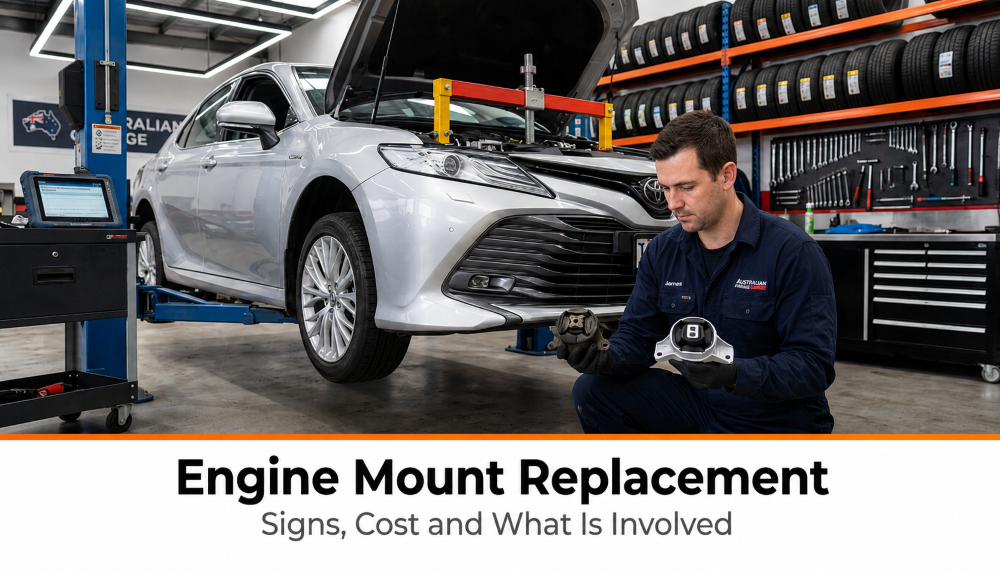
A clunk when you take off from the lights. A vibration through the cabin that wasn’t there last month. A knocking sound under the bonnet when you brake. These are the moments that send people searching for engine mount replacement and if you’ve landed here because your car is doing one of those things, you’re probably wondering the same three things: what’s actually wrong, is it safe to keep driving, and what’s this going to cost. Worth knowing upfront: engine mount and motor mount are two names for exactly the same part, so whichever term you’ve been searching, you’re in the right place. This guide covers what engine mounts actually do, how to recognise the signs one is failing, whether it’s safe to keep driving on it, how to tell it apart from a few other issues that feel similar, and roughly what replacement costs and involves.
What Is an Engine Mount (and What Does It Do)?
An engine mount is a bracket-and-cushion assembly, typically built from rubber or a rubber-and-hydraulic combination bonded to metal, that bolts the engine (and often the transmission) to the vehicle’s chassis. Most cars have several of them working together. Their job is twofold: hold the engine securely in place, and absorb the vibration and torque the engine naturally generates so it doesn’t transmit straight into the cabin and surrounding components. A healthy set of mounts is a big part of why a well-maintained car feels smooth at idle and under acceleration and why a failing one makes itself known fairly quickly.
How Many Engine Mounts Does a Car Have?
It varies by drivetrain layout and vehicle, so treat this as a general guide rather than a spec sheet for your specific car. Front-wheel-drive vehicles commonly run three mounts, rear-wheel-drive vehicles often have four, and all-wheel-drive or performance vehicles sometimes use additional mounts to manage the extra torque and drivetrain components involved. Your exact configuration will depend on your make and model.
Signs You Have a Failing Engine Mount
A deteriorating engine mount tends to announce itself through a handful of fairly recognisable symptoms:
- Cabin vibration a noticeably rougher, more pronounced shake through the seat or steering wheel, especially at idle or under acceleration
- Clunking, banging, or knocking typically most noticeable when accelerating from a stop, shifting gears, or braking, as the engine shifts more than it should against a worn mount
- Visible engine movement or tilt with the bonnet open and the engine running, a badly failed mount can allow the engine to rock or sit visibly off-centre
- Unusual noise under load rattling or metallic contact sounds that weren’t there before, particularly over bumps or during hard acceleration
- Rougher idle more vibration felt through the cabin while stationary with the engine running, since the mounts are working harder to absorb engine movement at rest
Is It Safe to Drive with a Broken Engine Mount?
This is the question most people actually want answered, and it deserves an honest, non-alarmist answer: it depends on how far the mount has failed, but it’s not something to leave indefinitely. A single mount showing early wear usually isn’t an immediate emergency you can typically still drive the car. The problem is what happens next. A failing mount puts extra strain on the remaining mounts, which weren’t designed to carry that additional load, so they tend to wear out faster than they otherwise would. Over time, this can affect drivetrain alignment, put extra stress on nearby components like exhaust connections and coolant hoses, and in more advanced cases, allow enough engine movement to affect handling or even cause a mount to fail outright. The practical advice: if you’re noticing clunking, vibration, or visible engine movement, get it inspected promptly rather than waiting to see how bad it gets. Catching it early is almost always a smaller, cheaper job than waiting for a full failure to cascade into other parts.
Engine Mount vs. Other Common Culprits
Several unrelated issues can produce symptoms that feel similar to a failing engine mount, so it’s worth a rough self-check before you assume you know what’s wrong though a proper diagnosis is still the only way to know for sure.
- Engine mount vibration or a clunk that’s most noticeable tied to acceleration, deceleration, or gear changes, rather than constant at all speeds
- CV joint typically a clicking or popping sound that appears specifically when turning, especially at full lock, rather than under straight-line acceleration
- Wheel bearing a humming or growling noise that changes pitch with vehicle speed, often more noticeable on a subtle curve or when weight shifts side to side
- Exhaust hanger or heat shield a rattling or buzzing noise, often at idle or over bumps, that’s more of a metallic rattle than a felt vibration through the cabin
- Transmission mount very similar symptoms to an engine mount, since it does a related job for the gearbox rather than the engine genuinely difficult to tell apart from an engine mount without a proper inspection
If your symptom ties closely to acceleration or gear changes, an engine (or transmission) mount is a reasonable first guess but this is exactly the kind of thing a quick visual and physical inspection settles definitively in a way guesswork can’t.
How Much Does Engine Mount Replacement Cost in Australia?
As a general, illustrative estimate, engine mount replacement across Australian workshops tends to fall roughly in the $400 to $850+ range, though this varies a fair amount based on a few factors:
- Vehicle make and model mount parts and labour access vary significantly between manufacturers, and some European or performance vehicles carry higher parts costs
- Number of mounts needing replacement replacing one mount costs less than replacing several, and a failing mount can accelerate wear on the others
- Labour difficulty and access some mounts are straightforward to reach, while others require more disassembly to safely support and access the engine
- Mount type standard rubber mounts are generally more affordable than hydraulic or performance-specific mounts
These figures are a general market guide, not a quote the only way to get an accurate number for your specific car is a proper inspection and upfront quote before any work begins.
Why Isn’t This a DIY Job?
Engine mount replacement looks simple on paper unbolt the old one, bolt in the new one but it carries more risk than that description suggests. The engine needs to be safely supported and stabilised before a mount is removed, since it’s briefly relying on the remaining mounts (and often a jack or engine support brace) to stay in position.
Getting the alignment and torque spec wrong on reinstallation isn’t just a quality issue it can reintroduce the exact vibration and drivetrain strain you were trying to fix, and in some cases create a safety issue if the engine isn’t secured correctly. It’s a job that rewards proper equipment and experience more than it first appears.
How Engine Mount Replacement Works
At a high level, a proper engine mount replacement follows a consistent process:
- The engine is safely supported and stabilised, typically with a jack or engine support brace, before any mount is disturbed
- The old, worn mount is removed
- The new mount is fitted and torqued to the manufacturer’s specification not just “done up tight”
- Engine positioning and alignment are rechecked to confirm everything sits correctly before the car goes back on the road
Frequently Asked Questions
How do I know if it’s my engine mount or something else?
Vibration or clunking tied specifically to acceleration, deceleration, or gear changes points toward an engine or transmission mount, while clicking on turns, speed-related humming, or rattling over bumps usually point elsewhere. A proper inspection is the only way to know for certain.
Can I drive with a broken engine mount?
Often yes in the short term, but it’s not something to ignore a failing mount puts extra strain on the remaining mounts and nearby components, and can get worse quickly. Get it inspected promptly rather than waiting to see how far it deteriorates.
How long does engine mount replacement take?
It varies by vehicle and how many mounts need replacing, but many jobs can be completed within a few hours to half a day access difficulty on your specific make and model is the biggest factor in how long it takes.
Do all engine mounts need replacing at once?
Not necessarily it depends on the condition of the others. Since a failed mount accelerates wear on the remaining ones, a technician may recommend replacing more than one if the others are already showing meaningful wear.
Is it worth paying more for premium mounts?
For most everyday driving, a quality standard mount is a perfectly reasonable choice. Performance or hydraulic mounts can offer benefits for high-torque or performance applications, but they’re generally not necessary for typical daily driving.
Book an Engine Mount Check in Rydalmere
If your car’s been clunking, vibrating, or just doesn’t feel as smooth as it used to, it’s worth getting it looked at properly rather than guessing. At I-FIX Autohaus in Rydalmere, our ASE certified technicians inspect and diagnose engine mount issues across all makes and models, with upfront quoting before any work begins and every repair backed by our 12 month / 12,000km nationwide warranty. Call us on 1300 010 888 or book an inspection online and we’ll tell you exactly what’s going on and what it’ll take to fix it.
