
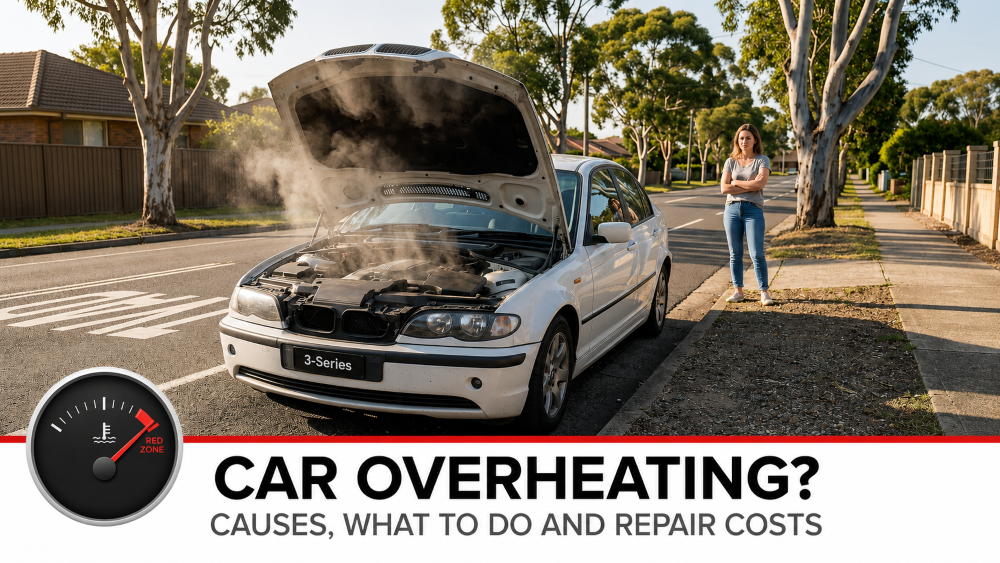
Steam curling out from under the bonnet. The temperature needle creeping toward the red. That sinking feeling that you’re about to be stuck on the side of the road. Car overheating is one of those problems that feels like an emergency in the moment and in some ways, it is but it’s also one of the most common reasons cars end up needing a repair booking. Most guides on this topic stop at “pull over and let it cool down.” This one goes further. Here’s what to do right now if your engine is running hot, what’s likely causing it, why idling and traffic can make it worse, and the part most guides skip entirely what engine overheating repair actually involves and roughly what it costs.
Signs Your Car Is Overheating
- Temperature gauge in the red the most direct signal; if the needle is climbing toward or past the hot end of the dial, take it seriously
- Steam or smoke from under the bonnet usually coolant vapour rather than actual smoke, but either way it means something’s escaping
- A sweet or burning smell a sweet smell often points to leaking coolant; a burning smell can mean oil or another fluid contacting a hot surface
- Loss of power or sluggish acceleration the engine management system can pull back power to protect itself once temperatures climb too high
- Dashboard warning lights a dedicated temperature warning light, or sometimes a general engine warning light, triggered by the car’s own sensors
What to Do When Your Car Overheats (Step by Step)
If you notice any of the signs above, work through this sequence rather than continuing on as normal:
- Turn off the air conditioning and turn the heater to max. This sounds counterintuitive, but running the heater pulls excess heat away from the engine and toward the cabin, taking some load off the cooling system.
- Find a safe place to pull over as soon as practical. Don’t wait for a perfect spot if the situation feels urgent the shoulder of the road is better than continuing to drive on an overheating engine.
- Turn off the engine and let it cool. Pop the bonnet release from inside if you can, but don’t touch anything under the bonnet yet give it at least 15 to 30 minutes, longer if it was seriously overheating.
- Check the coolant level once it’s fully cooled. Only open the coolant reservoir cap once the engine is genuinely cool to the touch a hot cooling system is pressurised and can cause burns.
- Decide whether to drive on or call for help. If coolant was simply low and you can top it up safely, a short, careful drive to the nearest workshop may be reasonable. If the problem returns quickly, or you’re not confident, call for a tow or roadside assistance rather than risking further damage.
What NOT to Do
- Don’t keep driving on it. Pushing on “just to get home” is one of the most common ways a simple, cheap fix turns into a major repair bill
- Don’t open the bonnet immediately. Hot steam and pressurised components can cause serious burns give it time first
- Don’t pour cold water on a hot engine. The sudden temperature change can crack the engine block or cylinder head, turning an overheating problem into a much bigger one
- Don’t ignore it just because it seems to settle down. A temperature that drops back to normal after you pull over doesn’t mean the underlying cause has gone away it usually just means the engine’s protective systems kicked in
Why Is My Car Overheating? Common Causes
Once you’re safely stopped, the underlying cause is usually one of a handful of common culprits:
- Low coolant or a coolant leak the most frequent cause; coolant escapes through a crack, worn seal, or loose connection somewhere in the system
- A faulty water pump the pump circulates coolant through the engine and radiator; if it fails or weakens, coolant flow drops and temperatures climb
- Damaged hoses or belts a cracked hose can leak coolant directly, while a failing drive belt can stop the water pump or fan from operating correctly
- A failing radiator blockages, corrosion, or physical damage can all reduce the radiator’s ability to shed heat from the coolant
- Low engine oil oil helps manage friction-generated heat as well as lubricating moving parts, so low or degraded oil can contribute to rising temperatures
- Thermostat failure a thermostat stuck closed prevents coolant from reaching the radiator when it needs to, trapping heat inside the engine
Why Is My Car Overheating While Idling or in Traffic?
This is a specific pattern worth understanding on its own, because it’s a genuinely useful early warning sign. At highway speed, airflow through the radiator helps cool the coolant passively, on top of whatever the radiator fan is doing. At idle or in stop-start traffic, that natural airflow disappears so the system relies much more heavily on the radiator fan and active coolant flow to keep temperatures in check. That’s exactly why a weak radiator fan, low coolant, or a struggling water pump often shows up first as overheating in traffic or at idle, well before it causes a problem at speed. If your car has run hot specifically while sitting in traffic or idling rather than at highway speed it’s a good early signal to get the cooling system checked before it fails somewhere less convenient, like the middle of a long highway drive.
What Happens If You Keep Driving on an Overheating Engine?
It’s tempting to push on if you’re close to home or a workshop, but sustained overheating gets progressively more damaging the longer it continues. Cylinder heads can warp under the heat, the engine block itself can crack, and in the worst case, you can end up with a blown head gasket the seal between the engine block and cylinder head failing under the heat and pressure. A blown head gasket is significantly more expensive to repair than most of the root causes that lead to it, which is really the core argument for acting early: the cost of pulling over and getting a coolant leak or failing water pump fixed is almost always smaller than the cost of repairing the damage caused by ignoring it.
Engine Overheating Repair: What’s Involved and What It Costs
This is the part most overheating guides skip entirely but if you’ve already had the experience, it’s usually the first thing you actually want to know. Here’s a general sense of what each common repair involves, with illustrative Australian cost ranges. Treat these as a rough guide only: actual pricing depends heavily on your specific make, model, and what a proper diagnosis finds.
Coolant Flush/Top-Up and Leak Repair
If the cause is simply low coolant or a minor leak, the fix often involves flushing and refilling the cooling system and repairing or replacing whatever’s leaking a hose clamp, a seal, or a small crack. Typical cost: roughly $150 to $400, depending on how accessible the leak is and whether parts need replacing.
Water Pump Replacement
This involves removing surrounding components to access the pump, fitting a new one, and refilling and bleeding the cooling system properly afterward. Typical cost: roughly $400 to $900, with the wide range reflecting how much labour is needed to reach the pump on different engine layouts.
Radiator Repair or Replacement
A minor radiator repair might address a small leak or blockage, while a full replacement is needed if the radiator is significantly damaged or corroded. Typical cost: roughly $400 to $1,200, depending on whether it’s a repair or full replacement and the vehicle’s specific radiator design.
Thermostat Replacement
Generally one of the more straightforward cooling system repairs the old thermostat is removed and a new one fitted, then the system is refilled and tested. Typical cost: roughly $200 to $450.
Hose or Belt Replacement
Replacing a cracked coolant hose or a worn drive belt is usually one of the more affordable fixes on this list, though cost rises if multiple hoses or belts need attention at once. Typical cost: roughly $150 to $400.
Head Gasket Repair
This is the costly worst-case outcome of prolonged overheating, and it’s a genuinely major job it involves removing the cylinder head, replacing the gasket, and carefully checking the head and block for warping or damage before reassembly. Typical cost: roughly $1,500 to $4,000+, and in more severe cases where the block or head is damaged beyond repair, cost can climb further still. The pattern across all of these is clear: the earlier you catch and fix the underlying cause, the smaller and cheaper the repair tends to be. An accurate price for your specific situation always depends on your make, model, and what a proper diagnosis actually finds these ranges are here to give you a realistic sense of scale, not a fixed quote.
How to Prevent Your Car from Overheating
- Check and exchange coolant regularly coolant degrades over time and loses its ability to protect the system effectively
- Get the cooling system, hoses, and belts inspected periodically catching a small crack or a weakening belt before it fails saves a breakdown later
- Act quickly on early warning signs a temperature gauge creeping up or overheating specifically in traffic is worth investigating before it becomes a full failure
- Keep up with scheduled servicing many cooling system issues get caught during a routine service before they turn into a roadside problem
Frequently Asked Questions
Is it safe to drive a short distance with an overheating engine?
Generally, no even a short distance can push a marginal problem into serious engine damage. If you can pull over safely, it’s almost always better to stop, let the engine cool, and assess the situation before deciding whether it’s safe to continue at all.
How long should I let my engine cool before checking coolant?
At least 15 to 30 minutes, and longer if the car was seriously overheating. The cooling system is pressurised when hot, so opening it too soon can cause burns from escaping steam and hot coolant.
Can low oil cause a car to overheat?
Yes oil helps manage friction-generated heat throughout the engine, so low or degraded oil can contribute to rising temperatures alongside whatever’s happening with the coolant system.
Why does my car overheat only in traffic?
At idle or in stop-start traffic, there’s little natural airflow through the radiator, so the system relies much more heavily on the radiator fan and coolant flow. A weak fan, low coolant, or a struggling water pump often shows up first in exactly these conditions.
How much does it cost to fix an overheating car in Australia?
It depends entirely on the cause a simple coolant top-up or hose repair might run $150 to $400, while a water pump or radiator job typically falls somewhere between $400 to $1,200, and a head gasket repair (the costly worst-case outcome) can run $1,500 to $4,000 or more. A proper diagnosis is the only way to know which category your car falls into.
Get Your Cooling System Checked in Rydalmere
Whether your car overheated once and seemed to settle down, or it’s been running warmer than usual for a while, it’s worth getting the cooling system properly checked before a minor issue turns into a major one. At I-FIX Autohaus in Rydalmere, our ASE certified technicians diagnose overheating issues across all makes and models, with upfront quoting before any work begins and every repair backed by our 12 month / 12,000km nationwide warranty. Call us on 1300 010 888 or book a cooling system check online and we’ll tell you exactly what’s going on and what it’ll take to fix it properly.
