If your brake pedal feels a bit spongy, there’s a warning light glowing on the dash, or it’s simply been a couple of years since anyone’s checked your brake fluid, you’re in the right place. This guide covers everything the other brake fluid articles skip over: what actually happens during a flush, the real difference between “bleeding” and “flushing,” why one-person bleeder kits exist, how ABS changes the process, and what a flush should set you back at a Sydney workshop.
What Does Brake Fluid Actually Do?
Brake fluid is the hydraulic fluid that transfers the force from your foot on the pedal through to the calipers or wheel cylinders, which clamp the brake pads against the rotors. Unlike engine oil, it’s not there to lubricate anything its whole job is to transmit pressure instantly and consistently, every single time you brake. Here’s the catch: brake fluid is hygroscopic, meaning it draws in moisture from the air over time, even inside a sealed system. As the water content builds up, two things start to go wrong:
- The fluid’s boiling point drops, which can lead to vapour lock that soft, sinking pedal feeling under hard or repeated braking. Think long descents through the Blue Mountains, or towing a van down a steep grade.
- Moisture starts corroding internal components from the inside out calipers, ABS modules, and steel brake lines all take the hit.
This is exactly why brake fluid needs replacing on a schedule, no matter how “fine” it looks in the reservoir.
DOT 3, DOT 4, and DOT 5.1 What’s the Difference?
Not all brake fluid is created equal, and using the wrong spec can affect performance or damage your seals.
| Type | Boiling Point (Dry) | Common Use |
| DOT 3 | ~205°C | Older vehicles, budget passenger cars |
| DOT 4 | ~230°C | Most modern passenger vehicles on Aussie roads today |
| DOT 5.1 | ~260°C | Performance vehicles, heavy towing (caravans, boats), track use |
DOT 3, 4, and 5.1 are all glycol-based and can generally be mixed, though topping up with a lower-spec fluid isn’t ideal. DOT 5 is the odd one out it’s silicone-based, doesn’t mix with the others, and is rarely seen in modern cars. Always check your owner’s manual (or logbook) before topping up or flushing, since using the wrong specification can void warranty claims on brake components. Our technicians confirm the correct spec for your make and model as standard practice during every logbook service.
Brake Fluid Flush vs. Bleeding Brakes What’s the Difference?
These two terms get thrown around interchangeably, but they’re not quite the same job:
- Bleeding brakes means clearing air bubbles out of the hydraulic lines usually done after a repair (like a new caliper or brake line) or when the pedal starts feeling spongy.
- Flushing the brake fluid means fully replacing all the old fluid in the system with fresh fluid, to get rid of moisture and contamination this is the routine maintenance job.
In practice, a proper flush always includes a full bleed, because you can’t push fresh fluid through the lines without clearing the air out too. So when you book a brake fluid flush with us, you’re getting both jobs done in one visit.
Signs You’re Overdue for a Brake Fluid Flush
- Spongy, soft, or “sinking” brake pedal
- Longer stopping distances than you’re used to
- Fluid in the reservoir looking dark brown or black (fresh fluid is pale yellow to clear)
- A brake warning light on the dash
- A burning smell after heavy braking (a sign of possible vapour lock)
- It’s been 2 years or 30,000km since the last flush whichever comes first
If the pedal feels spongy, don’t put it off. A compromised braking system is a safety issue, not just something to get around to. Our brake repair & service team can usually inspect and diagnose this the same day.
How Often Should You Change Brake Fluid?
Most manufacturers recommend a brake fluid flush every 2 years or 30,000km, whichever comes first check your specific logbook, since this can vary between makes. If you’re towing a caravan or boat regularly, carrying heavy loads, or driving in our hotter regions where under-bonnet temperatures run higher, some manufacturers recommend flushing annually. Heat cycling speeds up moisture absorption and fluid breakdown, and Sydney summers don’t do your brake fluid any favours. This is one of the checks we run as part of every minor and major logbook service at I-FIX AUTOHAUS, so it doesn’t get missed between visits.
How a Professional Brake Fluid Flush Works
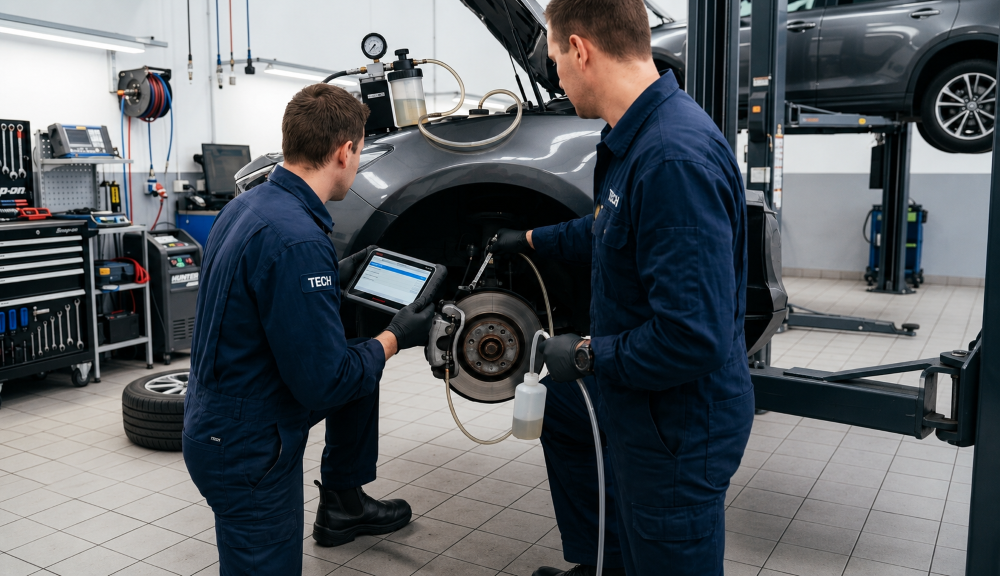
Here’s what actually happens during a proper flush, step by step:
- Inspection The technician checks fluid colour, contamination level, and reservoir condition, and looks for external leaks around the calipers, lines, and master cylinder.
- Fluid selection The correct DOT-spec fluid for your vehicle is confirmed against the manufacturer’s requirements.
- Draining Old fluid is drawn out of the master cylinder reservoir.
- Refilling The reservoir is topped up with fresh fluid to the FULL line.
- Bleeding in sequence Each wheel is bled in a specific order, starting with the brake furthest from the master cylinder and finishing with the closest. This order matters, because it clears air and old fluid progressively through the whole system rather than trapping air pockets near the master cylinder.
- Topping up between wheels The reservoir is monitored and topped up continuously. If it runs dry mid-bleed, air gets back into the system and the whole job has to start again.
- Final checks Pedal feel, fluid level, and all bleeder screws are checked for leaks, and the car is taken for a test drive to confirm braking performance.
Manual Bleeding vs. One-Person Bleeder Kits vs. Pressure Bleeding
There are three common methods used, and each has trade-offs:
- Manual (two-person) bleeding: One person pumps the pedal while another opens and closes the bleeder screw at each wheel. Reliable, but needs two people working in sync bad timing can push air back into the lines.
- One-person vacuum bleeder kits: A hand pump draws fluid and air out through a hose attached to the bleeder screw, so one person can do the whole job solo. Handy for a driveway job, but they can occasionally pull small amounts of air in past the bleeder screw threads, giving a falsely “clear” reading.
- Pressure bleeding: Fluid is pushed into the system under pressure from the master cylinder end, forcing air and old fluid out at each wheel. This is the method we use in our Rydalmere workshop for consistency and speed, and it’s generally the most reliable way to fully purge a system.
Why ABS-Equipped Vehicles Need Extra Care
Nearly every car on Australian roads built since the early 2010s has an anti-lock braking system (ABS) a hydraulic control unit sitting between the master cylinder and the wheels, with its own internal valves and passages. A standard manual or vacuum bleed often can’t fully clear the air trapped inside that unit. Most manufacturers require a scan tool-activated bleed sequence, which cycles the ABS valves open in a set pattern to purge air from inside the module something a driveway bleed simply can’t replicate. Our technicians use manufacturer-level diagnostic equipment to run this sequence correctly, which is often the missing step when a DIY bleed leaves the pedal still feeling soft.
Brake Fluid Flush Cost in Australia
Pricing varies by vehicle, location, and workshop, but as a general guide:
| Service | Typical Cost Range (AUD) |
| Standard brake fluid flush (passenger car) | $70 to $150 |
| Performance vehicles or high-spec fluid | $120 to $250+ |
| ABS scan-tool bleed (if required) | Often bundled into the flush price at specialist workshops |
DIY looks cheaper on paper a basic bleed kit runs $20–$60 and a litre of DOT 4 fluid is roughly $15 to $25 but that doesn’t factor in the risk of an incomplete bleed, ABS systems that need scan-tool cycling, or correct disposal of the old fluid (it’s classified as hazardous waste and can’t just be tipped down the drain or into stormwater). Get in touch with us for an exact quote based on your vehicle.
DIY or Professional? What’s Actually Worth Weighing Up
Brake fluid is one of the few fluids in your car where getting it even slightly wrong has an outsized consequence it’s the system standing between you and stopping safely. Before you tackle a DIY flush, have an honest think about:
- Does your car have ABS? If so, a full purge may need scan-tool cycling gear most home garages simply don’t have.
- Do you have a second person, or a solid one-person kit? Air left in the lines defeats the whole point of the job.
- Do you know your correct DOT spec? Using the wrong fluid can damage seals or void your warranty.
- Can you dispose of the old fluid properly? It’s hazardous waste in every state and territory.
If any of that gives you pause, it’s a job better off booked in than risked in the driveway and every brake flush we do is backed by our 12 month / 12,000km warranty.
Frequently Asked Questions
How often should brake fluid be changed?
Every 2 years or 30,000km for most vehicles, or annually if you tow, carry heavy loads, or regularly drive in hot conditions or hilly terrain.
What’s the correct order to bleed brakes?
Start with the brake furthest from the master cylinder and work progressively toward the closest one. This clears air and old fluid through the whole system rather than leaving pockets trapped near the start.
Can I bleed brakes by myself?
Yes, with a one-person vacuum bleeder kit though pressure bleeding, which most workshops use, is generally more reliable for a full purge, especially on vehicles with ABS.
How do I know if my brake fluid needs changing?
Check the reservoir fresh fluid is pale yellow to clear, while fluid that’s overdue turns dark brown or black. A spongy pedal or a dash warning light are also solid signs it’s time.
Is bleeding brakes the same as a brake fluid flush?
Not quite bleeding clears air from the lines (often done after a repair), while a flush replaces all the old fluid. A proper flush always includes a bleed as part of the job.
How much does a brake fluid flush cost in Sydney?
Typically $70 to $150 for a standard passenger vehicle, rising to $250+ for performance brakes or vehicles requiring an ABS scan-tool bleed. Contact us for a fixed quote on your vehicle.
Book Your Brake Fluid Flush with I-FIX AUTOHAUS
Brake fluid is easy to forget about because it doesn’t wear out visibly the way tyres or pads do but it’s doing the most safety-critical job in your whole car. With over 30+ years of experience servicing all makes and models in Rydalmere and across Sydney, our technicians can inspect, flush, and fully bleed your system ABS included while you wait, with a courtesy car available if you need to keep moving. Book your brake fluid flush now or call us on 1300 010 888 for a fixed price and a job done right the first time.
