
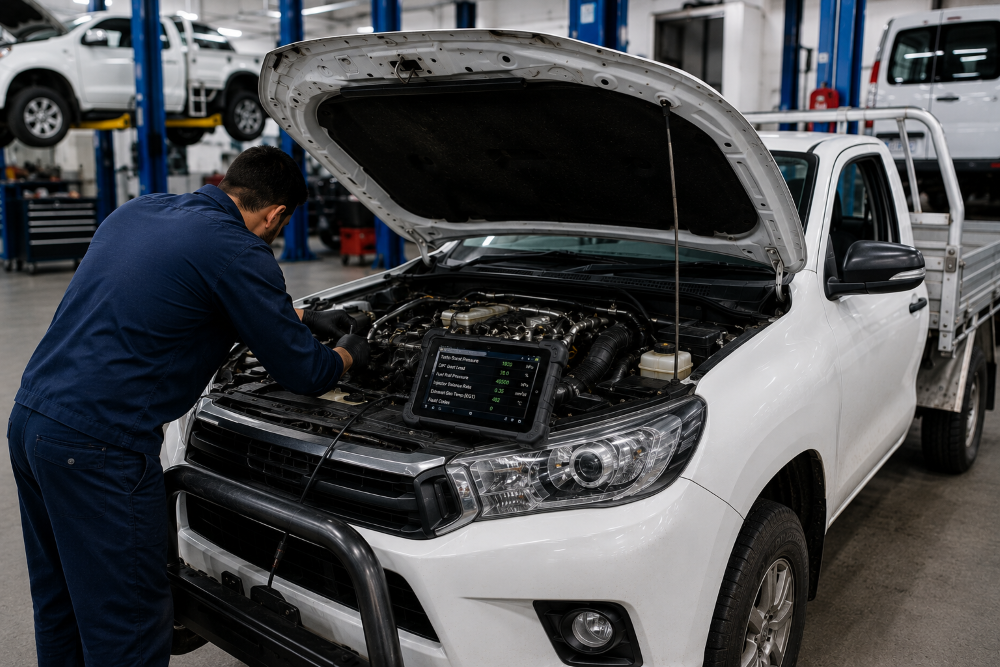
If you’re running a diesel ute, van or commercial vehicle in Western Sydney, your vehicle isn’t just transport it’s the tool that earns your income. Commercial vehicle repairs and servicing carry a different set of stakes from a passenger car service. Miss an interval or skip a specialist check, and the consequence isn’t an inconvenient breakdown it’s a day off the tools, a job delayed, and a client who’s calling someone else next time. Here’s why commercial diesels need a different approach and what that looks like in practice at I Fix Autohaus.
Why Diesel Commercial Engines Can’t Be Serviced Like a Petrol Passenger Car
Commercial diesel engines operate at higher sustained loads, longer daily run times, and under more demanding thermal conditions than most passenger car engines ever see. A tradie HiLux doing 60,000 km per year in Western Sydney traffic is working harder than the service book interval was designed around particularly if that driving is predominantly short urban trips, stop-start site-to-site runs, and towing under load. The consequence of passenger-car-style servicing on a commercial diesel isn’t just accelerated wear. It’s blocked DPFs, injector fouling, EGR carbon buildup, and turbo degradation all of which take the vehicle off the road at the worst possible time.
5 Things a Commercial Diesel Service Covers That a Standard Service Misses
- Higher-grade oil and shorter change intervals: Commercial diesels run hotter and harder than manufacturer base intervals assume. Extended oil change intervals on a heavily used diesel accelerate bearing wear, turbo degradation, and soot loading in the oil. A vehicle doing 60,000 km per year in urban conditions should be on 7,500 km oil change cycles not the standard 15,000 km interval.
- DPF monitoring and forced regeneration: Short urban trips are the primary cause of blocked Diesel Particulate Filters. A van or ute doing site-to-site runs in Parramatta or Blacktown rarely completes the sustained highway driving needed for passive DPF regeneration. A specialist diesel service monitors DPF soot loading and performs forced regeneration before blockage: not after the vehicle is already in limp mode.
- Fuel system and injector servicing: High-mileage commercial diesels accumulate injector deposits faster than passenger vehicles. Fouled injectors cause rough running, increased fuel consumption, and hard starts under load. A 10% improvement in fuel economy across a vehicle doing 50,000 km per year is a material cost saving not a minor adjustment. Injector health is a fuel bill conversation, not just a mechanical one.
- Turbocharger inspection at every service: Commercial turbos run under sustained load that passenger car turbos rarely see. Shaft play, seal condition, and VGT vane function should be checked at every major service not only when a symptom appears. Early turbo wear caught at a service is a rebuild. Missed until failure, it’s a replacement plus potential engine contamination.
- EGR cleaning and AdBlue/SCR system check: Stop-start urban driving accelerates EGR carbon buildup significantly. On modern Euro 5 and Euro 6 commercial diesels, AdBlue dosing and SCR catalyst function are emissions compliance issues a fault here can put the vehicle into limp mode regardless of mechanical condition. These systems need active monitoring, not reactive attention after the warning light appears.
Most Common Commercial Diesel Faults We See in Western Sydney
Across HiLux, Ranger, Triton, D-Max, Sprinter, Transit, Transporter, HiAce and Ducato vehicles, the faults we see most consistently in commercial operators from Parramatta and across Western Sydney are:
- Blocked or partially blocked DPF most common single fault in urban commercial diesels
- EGR valve carbon fouling causing rough idle and power loss
- Injector wear producing increased fuel consumption and smoke under acceleration
- VGT turbo vane seizure causing limp mode and boost loss frequently misdiagnosed as full turbo failure
- AdBlue system faults on Euro 6 vehicles triggering warning lights and reduced power modes
None of these are mechanical surprises for a specialist diesel workshop. All of them are preventable with the right service intervals and the right checks at each service.
How Often Should a Commercial Diesel Vehicle Be Serviced?
The manufacturer service book is a minimum baseline, not an optimum for commercial use. Our recommendations for Western Sydney commercial operators:
- Oil and filter: every 7,500 km or 4–6 months for vehicles doing high urban mileage
- Full commercial diesel service (inc. DPF check, EGR inspection, fuel system): every 15,000 km or 12 months
- Major service (inc. turbo inspection, injector service, AdBlue system): every 30,000 km or 24 months
Vehicles towing regularly, operating in dusty conditions, or doing consistent stop-start urban driving should sit at the shorter end of all these intervals.
Commercial Diesel Vehicle Repairs in Rydalmere Serving Western Sydney’s Trades and Fleets
I Fix Autohaus is located in Rydalmere in the heart of Western Sydney’s commercial and trades corridor. We service commercial diesel vehicles across construction, plumbing, electrical, landscaping, logistics and courier operations from Parramatta, Granville, Silverwater, Merrylands, Ermington and surrounding suburbs.
Practical details that matter for commercial operators:
- Same-day turnaround for most services your vehicle back working the same day where possible
- Courtesy vehicles and shuttle service you’re not off the tools while your ute is with us
- After-hours drop-off leave the vehicle the night before, collect it ready to go
- 12-month / 12,000 km warranty on all repairs one of the strongest independent workshop warranties in Western Sydney
- Multiple vehicles welcome we have capacity for regular fleet bookings
- AfterPay and Wizit accepted spread larger repair costs without disrupting cash flow
Conclusion
Your diesel ute or van is your business. Commercial vehicle repairs and servicing done correctly by a workshop that understands commercial diesel engines keeps it earning. The cost of proper specialist servicing is straightforward. The cost of getting it wrong shows up as a day off the road when you can least afford it.
Frequently Asked Questions
Q1: Can you service financed or leased commercial vehicles without voiding the warranty?
Yes under Australian Consumer Law, independent logbook servicing using manufacturer-specified parts and fluids keeps your warranty fully intact. We document every service correctly in your logbook and provide full service records for FBT, ATO and lease compliance. See our logbook servicing post for the full legal picture.
Q2: How quickly can you turn around a commercial vehicle?
Most standard diesel services are completed same day. We schedule commercial vehicles to minimise workshop time and can often accommodate priority bookings for operators who can’t afford extended downtime. Call us directly for urgent bookings we’ll work around your operational schedule.
Q3: Do you handle Euro 6 diesel systems AdBlue, SCR, DPF?
Yes. Modern Euro 5 and Euro 6 commercial diesels require workshop equipment capable of reading and programming emissions system fault codes beyond a basic OBD scanner. We have current diagnostic tools for DPF regeneration, AdBlue dosing calibration, and EGR system servicing across all common commercial diesel platforms.
