
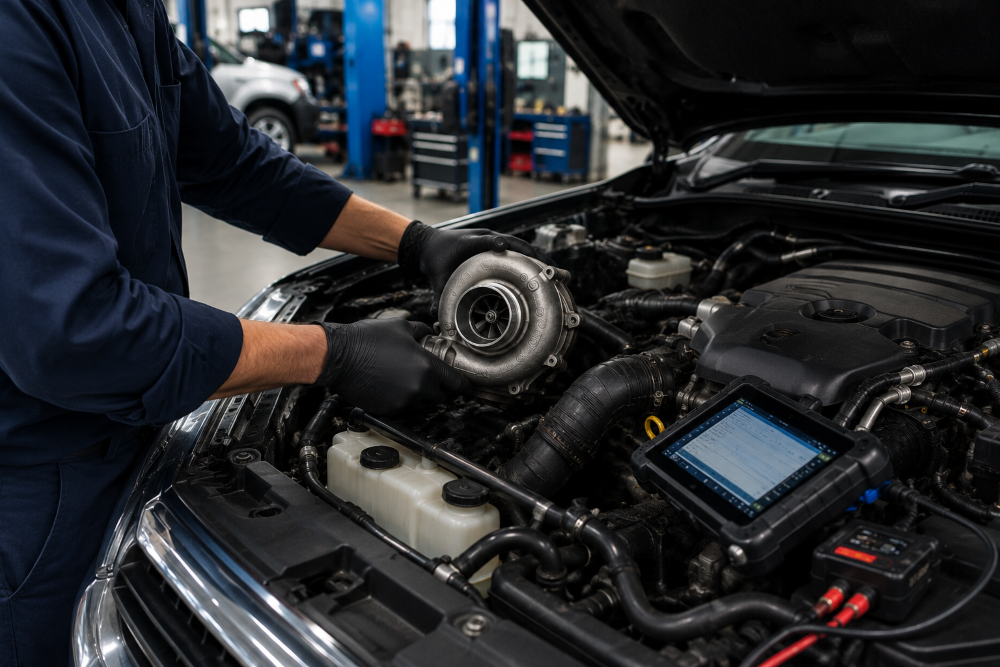
If you’re planning a turbo upgrade on your ute or diesel 4WD in Sydney, there’s a step most workshops skip: checking the condition of your existing turbocharger first. A larger turbo bolted onto worn bearings or failing seals won’t perform it’ll fail faster than the stock unit it replaced. Turbocharger repair and diagnosis should come before the upgrade conversation. Here are the six warning signs that your turbo is already telling you something and what to do about it.
Why Your Turbo’s Condition Matters Before Any Upgrade
Performance upgrades on a compromised foundation deliver disappointing results. A proper turbo diagnostic before the upgrade costs a fraction of the upgrade itself it either confirms you’re good to proceed, or identifies a repair that needs doing first and will affect the upgrade outcome if ignored. Checking your existing turbo isn’t a delay. It’s the step that makes the upgrade actually work.
6 Signs Your Turbo Needs Repair Before You Upgrade
- Whining or Whistling Under Boost: A new high-pitched whine increasing with boost pressure points to worn shaft bearings or compressor wheel damage. Caught early, a centre cartridge rebuild is often viable. Left alone, the shaft contacts the housing and the unit is scrap.
- Excessive Turbo Lag: Slower boost buildup isn’t always a tuning problem. Worn internal clearances and compressor wheel play reduce mechanical efficiency before any boost leak is present investigate the turbo’s physical condition first.
- Blue or White Exhaust Smoke Under Acceleration: Oil burning in the combustion chamber means failing turbo oil seals. In diesel vehicles, turbo oil leaks also accelerate DPF loading one problem quickly becomes two. Don’t let this be dismissed as ‘normal diesel smoke.’
- Loss of Boost Pressure: A measurable boost drop points to compressor wheel damage, wastegate failure, or upstream leaks. A boost gauge confirms whether pressure is actually reduced. Wastegate actuator failure is often repairable without full turbo removal.
- Rising Oil Consumption Without Visible Leaks: Oil disappearing without puddling under the car often means turbo seals are pushing oil into the intake. This is frequently misdiagnosed as piston ring wear a proper diagnostic distinguishes the two before anyone recommends an engine rebuild.
- Black Oily Residue in the Intercooler or Intake Pipes: A direct visual sign of compressor-side seal failure. In diesel vehicles it also coats the intake manifold and EGR system, compounding repair scope significantly the longer it’s left.
Turbo Repair vs Full Replacement What Your Car Actually Needs
The answer depends on the failure mode. Many workshops default to replacement when a repair is sufficient. General pathways:
- Bearing wear / shaft play often repairable with a centre cartridge rebuild if wheels are undamaged
- Oil seal failure repairable if caught before the shaft has worn the housing
- Compressor or turbine wheel damage almost always requires cartridge or full unit replacement
- VGT/VNT vane actuator seizure (diesel) often repairable with a vane mechanism clean and reset; frequently misdiagnosed as full turbo failure
- Wastegate actuator failure repairable independently in many applications without turbo removal
Add here: specific turbo makes/models your team commonly rebuilds vs replaces before publishing.
Diesel Turbo vs Petrol Turbo Different Failures
Diesel (HiLux, Ranger, BT-50, Triton, Patrol, LandCruiser)
Diesel turbos are more sensitive to oil quality degradation and VGT vane carbon buildup a common cause of limp mode often misdiagnosed as full turbo failure. A vane mechanism clean frequently resolves this without replacement.
Petrol (WRX, GTI, ST, RS, Stinger, i30N)
Petrol turbos run significantly hotter and are more prone to oil coking in the centre cartridge after hard use without a cool-down period. Shorter oil change intervals matter more here than on any other engine type.
Turbocharger Repair and Upgrade Costs in Sydney
- Turbo diagnostic and inspection: $120–$200 (credited toward repair if you proceed)
- VGT vane clean and reset (diesel): $250–$500
- Centre cartridge rebuild: $400–$900 depending on unit
- OEM replacement turbo (supply and fit): $1,200–$3,500
- Stage 1 hybrid turbo upgrade with remap: $1,800–$3,500
- Full turbo kit with intercooler and remap: $3,500–$7,000+
All quotes fixed before work begins. If repair is sufficient, we’ll say so.
Turbocharger Repair and Upgrades in Rydalmere What We Check First
Every turbo upgrade conversation at I Fix Autohaus starts with a diagnostic shaft play, boost pressure, oil feed and return condition, compressor seal integrity, and VGT function on applicable diesel units. We service HiLux, Ranger, BT-50, Triton, Patrol, Prado, and LandCruiser diesel turbos regularly, alongside petrol performance applications. Conveniently located for Parramatta and Western Sydney drivers most turbo diagnostics completed same day.
Conclusion
A turbocharger repair done before the upgrade isn’t a delay it’s the step that makes the upgrade deliver what you’re paying for. Diagnose first. Upgrade from a solid foundation. That’s the approach that produces lasting performance results.
Frequently Asked Questions
Q1: Can I tell if my turbo noise is a warning sign?
A new whining pitch or rattling that wasn’t there before is the signal. Healthy turbos make a smooth boost whoosh. A changed noise character higher, sharper, or intermittent means get it checked.
Q2: Will a failing turbo damage my engine if I keep driving?
Yes. Compressor wheel fragments entering the combustion chamber cause immediate severe engine damage. Oil starvation destroys a turbo in minutes. Diesel runaway from a failing seal is a real failure mode. Act on the signs early the repair cost escalates quickly once secondary damage begins.
Q3: How often should I change oil on a turbocharged vehicle?
More frequently than most service books specify. We recommend 7,500 km maximum for turbocharged engines under demanding use towing, 4WD, urban stop-start. Degraded oil is the single biggest cause of premature turbo bearing failure. Turbo longevity starts with oil quality.
Book a Turbo Diagnostic at Our Rydalmere Workshop Before Your Upgrade
Before you book a turbo upgrade, let our Rydalmere team check your existing turbo it could save you thousands. Full diagnostic, shaft play check, boost pressure test, oil system inspection same day for most vehicles. Contact I Fix Autohaus or book online serving Sydney, Parramatta, and Western Sydney.
