
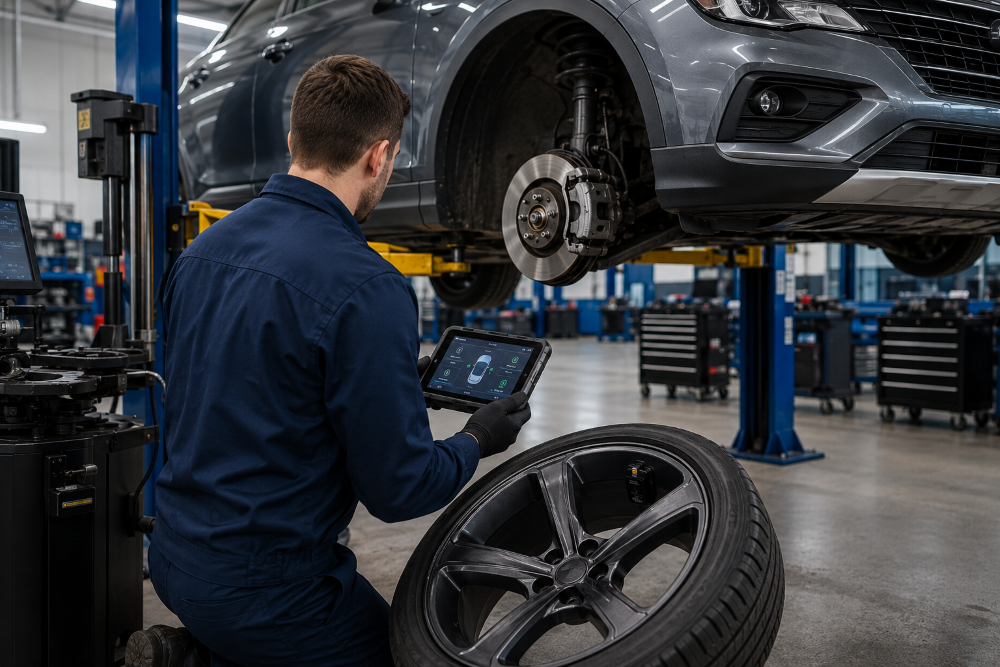
If you’re getting new tyres fitted in Sydney, your tyre pressure monitoring system mechanic should be part of the conversation not an afterthought. It’s one of the most commonly overlooked steps in a tyre replacement, and it’s the reason so many drivers leave the workshop with a tyre pressure warning light glowing on their dash before they’ve even made it home. TPMS sensors are small battery-powered devices mounted inside each wheel. They monitor your tyre pressure in real time and alert you when it drops to an unsafe level. But they’re sensitive, battery-dependent, and in many vehicles need to be reprogrammed every time new tyres are fitted. Here’s what you need to know before you book your next tyre change.
What Is a TPMS Sensor and Why Does It Matter?
The tyre pressure monitoring system (TPMS) is a safety feature fitted to most vehicles made after 2007. Each wheel contains a small sensor typically screwed into the valve stem or strapped to the inside of the rim that measures air pressure and transmits the data to your car’s ECU wirelessly. When pressure drops 25% or more below the recommended level, the system triggers the tyre pressure warning light on your dashboard. That’s your cue to check your tyres before a blowout or handling problem develops. What most drivers don’t realise is that the sensor itself can fail, lose battery power, or fall out of sync with the vehicle’s system particularly after a tyre change. That’s where the problems start.
Why Is My TPMS Light On After a Tyre Change?
This is one of the most common questions we hear at I Fix Autohaus. You’ve just had four new tyres fitted the car should be sorted. But then the TPMS light comes on and stays on. Here’s why it happens:
The Sensor Wasn’t Reprogrammed
Many vehicles require a TPMS reset or relearn procedure after new tyres are fitted. The system needs to “re-recognise” each sensor in its new position. Some vehicles do this automatically after a short drive; others require a tool-assisted TPMS reset procedure. If the tyre fitter didn’t complete this step, the light will come on.
The Sensor Was Damaged During the Tyre Change
TPMS sensors are mounted to the inside of the rim. During a tyre change, the sensor can be dislodged, cracked, or the valve stem can be overtightened or incorrectly seated. A tyre pressure sensor fault caused by physical damage during fitment is more common than most people expect especially at tyre shops that aren’t set up to handle TPMS carefully.
The Sensor Battery Is Dead or Nearly Dead
TPMS sensor batteries last between 5 and 10 years and are not user-replaceable in most designs. When the battery dies, the sensor stops transmitting and the system flags a tyre pressure sensor fault. If your car is more than 7 years old and the light has come on around or after a tyre change, a flat TPMS sensor battery is a very likely cause.
The Sensors Weren’t Transferred or Replaced
When tyres are swapped to new rims, the TPMS sensors must be transferred across or replaced. If this step is skipped, the new wheel assembly has no sensor and the system will flag a fault for every affected wheel.
TPMS Sensor Replacement in Rydalmere What’s Involved
When a vehicle comes to us with a tyre pressure warning light that won’t clear, we follow a structured diagnostic process:
- TPMS Scan: We read the system using dedicated TPMS diagnostic equipment to identify which sensor (or sensors) are at fault and why.
- Sensor Assessment: We determine whether the fault is a programming issue, a dead battery, a damaged sensor, or a missing sensor entirely.
- Repair or Replacement: Where a sensor can be reset or reprogrammed, we do that. Where the sensor has failed or the battery is flat, we replace it with an OEM-spec or quality aftermarket unit.
- Relearn Procedure: After any sensor work, we complete the full TPMS relearn or reset to ensure the system recognises every sensor correctly and the warning light clears.
- Pressure Check and Sign-Off: We verify correct tyre pressures across all four wheels before the car leaves.
This process is straightforward when it’s done properly from the start. The complications arise when a tyre change is done without tyre pressure monitoring system in mind and the driver ends up returning to a different workshop to fix what should have been handled the first time. Our Rydalmere workshop services TPMS on all makes and models, including European vehicles, which often have more complex sensor programming requirements than Japanese or Korean cars.
New Tyres and TPMS Programming Get It Right the First Time
If you’re booking new tyres, this is the question to ask before you confirm: “Do you handle TPMS sensor programming as part of the fitment?” Not every tyre shop does. Many budget tyre fitters fit the rubber, balance the wheels, and hand the car back TPMS light and all. They may tell you it will clear on its own after a few kilometres. Sometimes it does. Often it doesn’t. At I Fix Autohaus, new tyres TPMS programming is part of the process not an optional extra. We check sensor condition before fitment, transfer or replace sensors where needed, and complete the relearn procedure before the car leaves. You drive away with new rubber and a clear dash.
This is particularly important for drivers running:
- Winter or seasonal tyres swapped between two sets of rims
- Aftermarket rims where sensors need to be transferred or replaced
- Older vehicles (7+ years) where sensor batteries are approaching end of life
- European vehicles with proprietary TPMS programming requirements
How Much Does TPMS Sensor Replacement Cost in Sydney?
TPMS sensor cost varies depending on the vehicle make, the type of sensor (OEM vs. aftermarket universal), and how many sensors need replacing.
As a general guide for Sydney drivers:
- TPMS reset / relearn only: $50–$100 (where sensors are intact and just need reprogramming)
- Single sensor replacement: $80–$180 per sensor (parts and labour, depending on sensor type)
- Full set of four sensors: $280–$650 (varies significantly by vehicle European vehicles typically sit at the higher end)
- TPMS sensor battery replacement: Not applicable for most sensors the battery is sealed inside and the entire sensor unit is replaced when it fails
These are general ranges. We provide a fixed quote before any work begins no surprises.
Conclusion
Your TPMS is a safety feature not a minor inconvenience to dismiss. When you replace your tyres, the TPMS sensors need to be part of the process. Whether that means a simple reset, a battery replacement, or a full sensor replacement, it’s a straightforward job when it’s handled correctly from the start. Don’t drive away from a tyre change with a warning light on your dash. And don’t let a tyre shop wave it off as something that will clear itself. A qualified tyre pressure monitoring system mechanic will get it sorted properly so your safety system is actually doing its job.
Frequently Asked Questions
Q1: Can I drive with the TPMS warning light on?
You can, but you lose the benefit of real-time tyre pressure monitoring which is the whole point of the system. If the light is on because of a sensor fault (not because a tyre is actually low), you won’t receive any warning if a tyre does lose pressure. It’s worth fixing properly rather than ignoring.
Q2: Will the TPMS light go off on its own after a tyre change?
Sometimes yes on vehicles that use a drive-to-relearn system, the light can clear itself after driving at a steady speed for 10–20 minutes. But if the light is still on after that, it won’t clear without a tool-assisted TPMS reset or sensor repair. Don’t wait weeks hoping it resolves it usually won’t.
Q3: Do all cars have TPMS sensors?
Most passenger vehicles manufactured from 2007 onwards have direct TPMS fitted as standard. Some older vehicles use an indirect TPMS system that uses the ABS wheel speed sensors rather than dedicated tyre sensors these don’t have replaceable sensor units but do need to be recalibrated after a tyre change.
Q4: How do I know if it’s a TPMS fault or an actual flat tyre?
Check your tyre pressures manually with a gauge first. If all four tyres are at the correct pressure and the light is still on, the issue is with the TPMS system itself rather than the tyre pressure. A scan will confirm which sensor is at fault and whether it’s a battery, damage, or programming issue.
Q5: Are aftermarket TPMS sensors as good as OEM?
Quality universal TPMS sensors from reputable brands perform comparably to OEM units for most vehicles. The key is proper programming a universal sensor needs to be programmed to match your vehicle’s specific frequency and protocol. We only use sensors we’re confident in, and we program them correctly every time.
Q6: Do you service TPMS for drivers coming from Parramatta and the surrounding area?
Yes I Fix Autohaus is based in Rydalmere, making us easily accessible from Parramatta, Western Sydney, and surrounding suburbs. We handle TPMS sensor replacement, programming, and reset for all vehicle makes and models, including European and prestige vehicles.
Book TPMS Service Alongside Your Tyre Change
Booking new tyres? Ask us to check your TPMS sensors at our Rydalmere workshop we’ll inspect, reset, or replace them as part of the tyre fitment process so you drive away with a clear dash and fully functioning safety system. TPMS light already on from a previous tyre change? We can diagnose and fix that too same day in most cases. Contact I Fix Autohaus or book online serving Sydney, Parramatta, and Western Sydney.
