
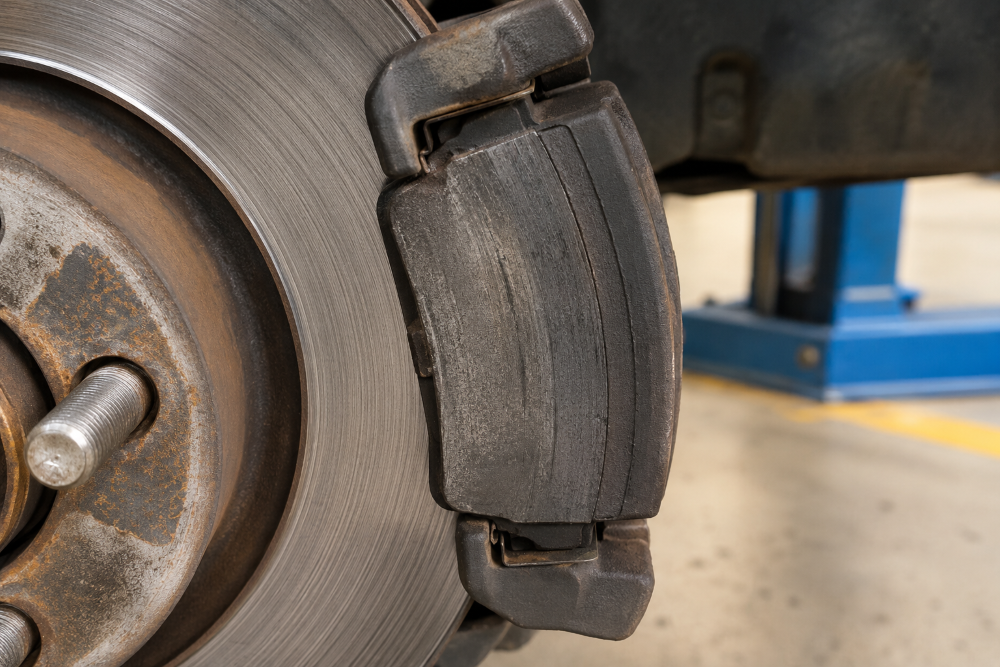
Brake pads and rotors replacement in Sydney is one of the most common and most misquoted services on any mechanic’s job sheet. If you’ve just been handed an estimate and aren’t sure whether you need pads, rotors, or both, this guide is for you. We’ll walk through how each part works, how to read the warning signs, what the numbers on your rotor actually mean, and what you should realistically expect to pay.
Brake Pads vs. Rotors: What Each Part Actually Does
Your braking system works like a clamp. The rotor is the large cast-iron disc bolted to your wheel hub it spins with the wheel every time you drive. The brake pads are blocks of friction material held in a calliper on either side of that rotor. Press the brake pedal, hydraulic pressure pushes the pads against the rotor, and friction converts your car’s speed into heat. Pads are the sacrificial component they’re designed to wear down so the rotor doesn’t have to. Rotors are built to outlast multiple sets of pads, but they’re not indestructible. Heat, surface scoring, and minimum-thickness limits all eventually bring them to the end of their service life.
Key takeaway: Pads wear faster by design. Rotors wear slowly until they don’t.
How Long Do Brake Pads and Rotors Last in Australian Conditions?
Brake pads on a typical Sydney car last between 25,000 and 65,000 km, depending on driving style, traffic patterns, and the compound used. Stop-start city driving eats through pads significantly faster than freeway commuting.
Rotors generally survive two to three sets of pads roughly 60,000 to 100,000+ km but a few local factors accelerate that timeline:
- Heat cycling from Sydney’s summer stop-start traffic
- Road grit and fine debris that acts as a mild abrasive on the rotor face
- Extended parking that causes surface rust, especially near the coast
- Aggressive or late braking habits that spike rotor temperatures
Understanding your driving environment helps set realistic expectations for service intervals.
Signs Your Brake Pads Are Worn (and How to Tell the Difference from Rotors)
Worn pads and worn rotors produce different symptoms. Here’s how to read them:
Worn brake pads:
- High-pitched squealing when braking the built-in wear indicator doing its job
- Grinding or metal-on-metal sound once the pad material is fully gone
- Longer stopping distances or a “soft” pedal feel
Worn or damaged rotors:
- Pulsing or vibration through the brake pedal often felt in the steering wheel too
- Visible grooves, scoring, or a raised lip around the outer rotor edge
- Shuddering when braking from highway speeds
If you’re experiencing pedal vibration rather than squealing, the problem is likely the rotor surface not just the pads.
What Is Rotor Warping and Why Does It Cause Steering Vibration?
“Warped rotors” is the common shorthand, but what’s actually happening is uneven thickness variation across the rotor face. Over repeated heat cycles, microscopic amounts of pad material transfer unevenly onto the rotor. The result is a surface that’s slightly thicker in some spots than others. When you brake, the calliper squeezes across those high and low spots in quick succession producing that rhythmic pulsing you feel through the pedal and sometimes the steering wheel. It’s not dangerous in the early stages, but it worsens progressively and accelerates pad wear.
Prevention tip: After hard braking on a long descent, for example keep rolling slowly for 30–60 seconds rather than stopping with the pedal held down. This lets the rotors cool evenly while spinning, rather than developing a hot spot where the pad rests.
Minimum Thickness: When Rotors Must Be Replaced, Not Resurfaced
Every rotor has a minimum discard thickness a number stamped or cast directly into the metal. Once worn to that point (typically 8–20 mm depending on the vehicle), the rotor must be replaced. There’s no exception for budget reasons: a rotor below minimum thickness doesn’t have enough mass to safely absorb and dissipate braking heat, which leads to fade, cracking, or failure.
Some mechanics offer resurfacing (also called machining or skimming) as an alternative to replacement. This is legitimate when:
- The rotor is above minimum thickness with room to spare
- The surface has minor scoring or uneven deposits not deep grooves
- The rotor is not cracked or showing heat stress marks (bluing)
If your rotor is already close to the minimum, resurfacing just moves it closer to discard. In that case, replacement is the smarter and safer spend.
Not sure if your rotors are within spec? Book a brake inspection at I Fix Autohaus we’ll show you the wear, not just tell you.
Should You Replace Pads and Rotors at the Same Time?
Not always but more often than not, yes. Here’s the logic:
New brake pads need to bed in to the rotor surface over the first 300–500 km of gentle use. If the rotor face is grooved, scored, or has uneven deposits, the new pads can’t make full contact. Performance is compromised, the pads wear unevenly, and you’re back in the workshop sooner than you should be. Replace pads only when rotors are above minimum thickness and the surface is smooth and even. Replace both when rotors are borderline on thickness, visibly scored, showing vibration symptoms, or when you’re doing a full-axle service and want to get the most out of your new pads. Doing both together also saves on labour the calliper and wheel are already off the car.
How Much Does Brake Pads and Rotors Replacement Cost in Sydney?
For most standard passenger vehicles, a front brake service (pads + rotors, both sides) in Sydney falls in the range of $300–$600 per axle. Rear brakes are similar, though some vehicles use drum brakes at the rear which changes the service entirely.
Costs vary based on:
- Vehicle type: European makes, SUVs, and performance cars carry higher parts costs
- Parts quality: OEM or quality aftermarket pads outperform budget alternatives in noise, dust, and longevity
- Labour rate: Rydalmere and Western Sydney workshops are generally more competitive than inner-city pricing
When comparing quotes for brake pads and rotors replacement in Sydney, the cheapest option isn’t always the best value. A set of budget pads that squeals, dusts, and wears out in 20,000 km costs more in the long run than quality parts installed once and done properly.
At iFix Autohaus in Rydalmere, we quote transparently, explain exactly what needs replacing and why, and use parts we’d put on our own cars. For context on what a full vehicle health check includes alongside brake work, see our Car Servicing & Repair page or learn what we look for during a Pre-Purchase Inspection.
Final Word
Understanding what’s worn pads, rotors, or both puts you in a far better position when dealing with any workshop. The warning signs are readable, the specs are measurable, and the decision to replace one or both has clear logic behind it. There’s no need to feel pressured into a job you don’t understand. Not sure if your rotors need replacing? Book a brake inspection at iFix Autohaus we’ll show you the wear, not just tell you. Book online here or call our Rydalmere workshop.
